


With over two decades of experience, I’m here to tell you this:
Contrary to what you may have heard — or even said — Agile didn’t fail us.
It just never taught us how to manage flow.
Your team might have stand-ups, retros, and a nicely colour-coded board. But the work — the actual search for value — still crawls. Deadlines slip. Estimates? Guesstimates more like, and that extra time you spent making them “precise”? Probably more waste than accuracy.
People are busy. But nothing’s really getting done.
Sound familiar?
Here’s the uncomfortable truth:
If you’re not managing flow, you’re not managing delivery.
You’re just organising the chaos — and calling it Agile.
Rituals Don’t Fix Systems
Agile made a promise: better collaboration, faster delivery, happier teams.
And what did most organisations do?
They ran headfirst into rituals.
Stand-ups, retros, backlog grooming.
Sprints, planning poker, story points.
Process everywhere. Flow? Not so much.
You can run the Agile playbook to perfection and still have work aging silently in progress.
You can have teams “fully utilised” and still have stakeholders breathing down your neck asking where the outcomes are.
Why?
Because ceremony without systems thinking is just theatre.
Agile rituals can help — but only if they’re in service of a system that flows.
And most teams? They’re managing the people, not the work.
They’re optimising meetings, not movement.
They’ve turned “doing Agile” into a checklist — and flow, if they’re even aware of it, into an afterthought.
Here’s the reality I see again and again:
- Stand-ups don’t fix stuck or aging work — they’re often just a futile exercise in holding people accountable for being busy.
- Retros don’t reduce cycle time — mostly because teams spend their time explaining what movie character they felt like during the sprint instead of examining the data their process is already generating that could actually help them address it.
- Sprint planning doesn’t forecast delivery risk — it just locks in a plan nobody truly believes.
And the kicker?
They were never meant to.
Agile rituals give structure to a process.
But if your underlying system is bloated, overloaded, or opaque?
You’re just painting a house where the basement is full of water.
What Flow Actually Means (And Why It’s Not a Buzzword)
Flow isn’t about being “in the zone.”
It’s not a vague feeling of momentum. It’s not just moving work across a board.
Flow is the movement of potentially valuable work through a system — from idea to reality — in a way that’s visible, trackable, and improvable.
Let’s pause on that for a second:
Potentially valuable.
Because the truth is, most of what we deliver is based on assumptions.
We think it will help.
We hope it will fix a problem, satisfy a desire, or meet a need — expressed or otherwise.
But until someone on the receiving end of the work tells us, “Yes, this helped” (or, more often, “No, not really”) — value is unconfirmed. Hypothetical. A bet.
That’s why flow matters. Because if your work isn’t moving, the system can’t generate feedback.
Without feedback, you’re not validating value — you’re assuming it. You might be right. But you’ll have no way to know, no way to repeat it, and no way to improve on it.
So, if flow is the system, what do we measure to understand it?
Not burndowns. Not points. Not how “busy” everyone looks.
You measure what actually moves. You measure how long it takes.
You measure whether things are finishing, not just starting.
Here are the four essential flow metrics:
1. Work In Progress (WIP)
How many things are we trying to do at once?
WIP is your system’s load. Let it climb, and responsiveness tanks. Let it stay high, and you’ll wonder why everything feels slow — all the time.
2. Work Item Age
How long has each work item been in progress?
Old work is risky work. The longer something hangs around, the more likely it’s stalled, stuck, or out of sync with what’s needed now.
3. Throughput
How much work do we finish per time unit?
Not started — finished. Throughput gives you your actual pace. It’s the only stable ground for any forecast that deserves to be trusted.
4. Cycle Time
How long does it take to finish something once we start it?
This is how responsive your system really is — not how long people are working, but how fast value (or potential value) gets to someone who can tell you if it mattered.
Flow ≠ Efficiency. Flow = Feedback.
Teams obsessed with efficiency can burn months delivering something fast that nobody needed.
Teams who manage flow create learning loops — systems that help them find out faster whether they’re delivering something that matters.
Here’s the truth:
If your work isn’t moving, it’s not generating feedback.
And if you’re not getting feedback, you’re not validating value — you’re assuming it.
Sure, you might get lucky.
Your solution might be right.
But without feedback, you won’t know how right or wrong it is or how to do better next time.
And if you can’t tell the difference, you’re not managing value — you’re just hoping for it.
If ROI Is Unknowable, Manage the Investment
ROI looks great on a slide. But in the real world?
You can’t measure return on work that hasn’t landed, been used, or been fed back on.
Value is emergent. ROI is hindsight.
So, what can you control?
Not the return.
The investment — and how long you’re exposed to risk.
And that investment?
It’s not just budget.
It’s not just effort.
It’s time.
More specifically, Cycle Time.
Cycle time is your Time to Feedback.
The longer it is, the more you’re spending without learning.
If you can’t confidently measure value upfront, then shorten the distance between idea and evidence.
Because the only thing worse than being wrong…is being wrong slowly.
“In the absence of knowable ROI, cycle time is your risk exposure.”
The Flow Frictions Killing Your Delivery (and How to Spot Them)
If you’re not actively managing flow, then friction is managing it for you — quietly, constantly, and expensively.
Most delivery dysfunction isn’t dramatic. It’s not the Big Red Project That Failed.
It’s the slow rot of unseen blockers, oversized work, and overloaded systems.
Here are the non-obvious flow killers I see every week — and how to spot them before they bury your roadmap.
1. Work That’s Too Big to Flow
“We’ll just finish it next sprint.”
Except you won’t. Because it’s not sized to finish.
When work items are too big, three things happen:
- You can’t see progress until it’s almost done.
- You can’t forecast anything except disappointment.
- And worst of all? The world moves on.
The customer’s need evolves. The context shifts.
By the time the work’s done, it’s either partially abandoned, no longer relevant, or shaped for a version of the problem that no longer exists.
Watch for:
- Stories or tickets that span multiple sprints.
- Epics that haven’t closed in 3+ months.
- Anything labeled “spike” that never got smaller.
Fix it:
Right-size the work. If an item can’t be reasonably expected to finish soon, it doesn’t belong in progress.
That’s not discipline — that’s flow hygiene.
Right-sizing isn’t about breaking everything into crumbs.
It’s about shaping work so it can flow, not fester.
You’re not trying to make everything tiny.
You’re trying to make everything finishable — fast enough to learn, early enough to adjust, and small enough to forecast.
2. WIP-in-Disguise
Not all flow problems are easy to see.
Some hide behind well-meaning structure.
You’ve split the epic. You’ve created stories. You’ve sliced “small.”
But somehow, it still takes forever.
Why?
Because that so-called story still carries the full weight of the epic.
It’s not independently testable, releasable, or even understandable on its own.
It’s WIP-in-Disguise — and it’s one of the sneakiest forms of hidden overload.
Symptoms of WIP-in-Disguise:
- Stories that reference each other to make sense.
- Stories that all have to ship together to be useful.
- A single story taking multiple people across multiple sprints to finish.
Fix it:
Treat independently valuable as your definition of right-sized.
If it can’t move, test, or finish on its own, it’s still too big — no matter how small the card looks on the board.
3. WIP Is Out of Control
“We’ve got ten things in motion — we’re really productive!”
No, you’re just busy.
High WIP means everything slows down, feedback loops stretch, and priorities blur. It’s delivery traffic — and nobody’s getting anywhere fast.
Watch for:
- More cards in progress than team members.
- Boards with “In Progress” columns 3x longer than “Done.”
- Frequent context-switching in standups.
Fix it:
Set a WIP limit. Then, actually honour it.
Yes, it will feel uncomfortable.
Yes, it will surface difficult choices.
That’s the point.
WIP limits aren’t about starving teams of work — they’re about protecting flow and forcing focus over false productivity.
When you constrain WIP:
- Work finishes faster.
- Blockers surface sooner.
- Priorities stop colliding in midair.
WIP limits aren’t a constraint.
They’re a signal that you’ve stopped saying yes to everything — and started designing for flow.
4. Work Isn’t Prioritised Once It’s In
“It’s all priority one.”
Then nothing is.
Most teams prioritise at intake — and then never again. Once work is “in progress,” it’s out of sight, out of mind. However, in a flow system, prioritisation is ongoing. Every day, you’re making decisions about what to finish next — and those decisions shape everything from risk to trust.
The result of not managing this?
- Old items linger while shiny new ones leapfrog.
- Critical work silently ages.
- The system stalls, even when people are “busy.”
Fix it:
- Create a clear pull policy.
- Visualise work item age.
- Prioritise flow, not just backlog order.
And when in doubt?
If all else is equal — pull the oldest item first.
Because work that waits silently isn’t harmless.
It’s hiding risk, delay, and decay.
5. Blockers Are Normalised
“Yeah, that’s always waiting on legal/data/another team.”
Cool. So you’ve accepted that your system’s broken.
Blockers should be treated like fire alarms — not background noise. If work is blocked, the system has failed to support flow. And the system is yours to improve.
Watch for:
- Blockers that last longer than active work.
- A “blocked” column that’s basically permanent.
- Silence around systemic delays.
Fix it:
Don’t track blockers. Investigate them. Cluster them. Fix the top 3 repeat offenders, and watch your flow improve overnight.
6. Expedites Run the Show
“This has to go through. It’s a special case.”
Of course it is. So were the last four.
Expedites are the sugar rush of delivery: instant gratification, long-term damage. They trash predictability, consume slack, and leave everything else in a pile of flow debt.
Watch for:
- Repeated “just this once” exceptions.
- Work items that skip the process entirely.
- Teams quietly resentful about getting pre-empted — again.
Fix it:
Limit your expedite lane. Make it visible. Control it with policies.
- Set a hard WIP limit: even if that limit is one.
- Define clear entry criteria: what really qualifies as an expedite?
- Track the frequency: if you’re expediting weekly, it’s not an exception, it’s a process failure.
And most importantly: make the cost of expediting visible.
Every expedite delays something else.
So treat them like credit cards — you can use them, but you will pay them off.
If you want flow, you can’t let urgency run the system.
Expedites should be rare, deliberate, and slightly painful — that’s how you know they’re being used responsibly.
And ask the question no one wants to: What are we doing wrong that makes so many things urgent?
Flow frictions are everywhere. Most teams normalize them.
The best teams expose them — then design them out of the system.
Agile Without Flow Is a Dangerous Game
You can follow Agile by the book and still fly straight into a wall.
Because Agile gives you structure, flow gives you feedback.
Here’s what Agile doesn’t tell you:
- How many things are too many.
- How long things should take.
- What “done” really costs when work gets stuck.
- Why everything feels urgent, but nothing feels predictable.
Agile frameworks are deliberately lightweight. That’s not the problem — the problem is how teams fill in the blanks. Most organisations respond to delivery pain by tightening the rituals, not fixing the system.
What you end up with is this:
- Teams perfectly executing a broken process.
- Backlogs full of wishful thinking, not right-sized work.
- Roadmaps driven by belief, not evidence.
- Metrics that look good until the product fails to land.
And because it’s “Agile,” no one challenges it.
Let’s Be Blunt:
Agile without flow is just busyness in a hoodie.
If you don’t manage:
- Work item age, you won’t know what’s stale.
- Cycle time, you won’t know what’s slow.
- Throughput, you can’t forecast anything.
- WIP, you’re drowning in your own multitasking.
Agile can help you organise your process.
But only flow tells you how well it’s working — and how to improve it.
Agile’s not bad. But it’s incomplete.
And until you see your delivery system as a flow system, you’ll keep tripping over the same hidden failures — no matter how many sprint ceremonies you run.
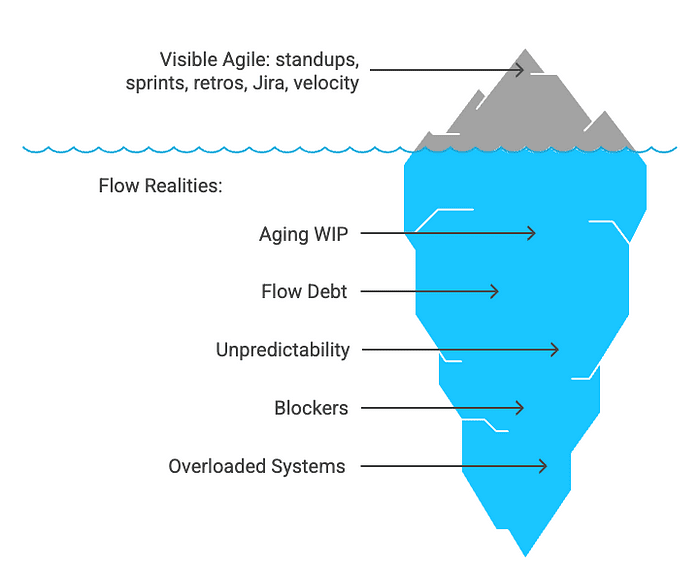
What Flow-Led Delivery Actually Looks Like
So what does it look like when teams do manage flow?
Not perfectly — that’s not the goal.
But deliberately. Visibly. Systematically.
These aren’t magical unicorn teams. They’re just doing something most teams don’t: they manage the work, not just the workers. They treat delivery like a system — one they can shape, study, and improve.
Here’s what you’ll see when flow leads:
1. Work is Right-Sized to Finish, Not Just to Start
They don’t pull work because it fits nicely in the backlog. They pull work because it’s shaped to flow.
Ask yourself: Can this item be finished in a few days, not weeks?
If not, what’s stopping us from slicing it smaller?
Because “in progress” isn’t progress if it never gets done.
2. WIP Is Capped — and That Cap Hurts
Flow-led teams say no to starting something new, even when someone’s free.
Why? Because they know finishing is the goal. Not starting. Not appearing busy.
They limit WIP because:
- It shortens feedback loops.
- It exposes blockers fast.
- It forces prioritisation — not wishful multitasking.
They don’t feel efficient all the time. But they are.
3. Flow Metrics Used Every Day
Not just in a report. Not just once a quarter.
Every. Single. Day.
- If work item age is climbing, swarm.
- If WIP is up, pause intake.
- If throughput drops, investigate the system — not the people.
Successful teams treat these numbers like vital signs, not performance scores.
4. Forecasting Is Probabilistic, Not Political
No one’s promising “done by Friday.”
Instead, they’re saying:
“There’s an 85% chance this batch will finish by the 24th, based on the last 60 days of real delivery.”
And guess what?
Stakeholders trust it.
Because it’s based on evidence, not optimism.
5. Blockers Are Diagnosed, Not Tolerated
Flow-led teams don’t shrug at blockers.
They surface them, study them, and solve them at the system level.
They ask:
- Is this a repeat pattern?
- What team or function do we need to enable, not blame?
- Could we redesign the work to avoid this altogether?
Because every blocker is a chance to build a better system.
6. They Don’t Worship the Roadmap — They Manage Flow to Outcomes
They’re not shipping features to say they shipped.
They’re shipping to learn what works. To deliver value. To change outcomes.
And they understand that to get there, they need a delivery system that:
- Finishes what it starts
- Surfaces risks early
- Builds trust through evidence
Bottom line:
- Agile is about what the team does.
- Flow is about what the system enables.
And when you manage the system, the team starts to thrive.
Sidebar: Flow Isn’t Extra Work — It Is the Work
Managing flow isn’t overhead. It’s not a nice-to-have. It’s not something you tack on after the “real work” gets done.
Flow is the system doing the work — or preventing it.
If you’re not managing flow, you’re managing chaos.
And chaos doesn’t scale. It burns out teams, blindsides leaders, and buries outcomes.
Want predictability?
Want trust?
Want speed that lasts?
Start with flow.
The Shift That Changes Everything
You don’t need to throw out Agile.
But you do need to stop mistaking structure for system health.
Because until you manage flow, you’re just running delivery theatre — busy, expensive, unsatisfying theatre. And your audience (stakeholders, customers, teams) can feel it.
The shift is simple, but powerful.
Stop asking:
- Are we doing Agile right?
Start asking:
- Is value flowing?
Because when you focus on flow:
- Delivery gets faster — but also safer.
- Forecasts become useful — not political.
- Teams stop firefighting — and start finishing.
- Leaders get signal — not noise.
- The product improves — because feedback is real-time, not postmortem.
This Isn’t About Doing More. It’s About Seeing Differently.
Flow isn’t just a metric layer. It’s a mindset.
One that stops blaming the team, and starts tuning the system.
One that doesn’t settle for “busy” — it demands value.
And once you see delivery this way, you don’t unsee it.
Final Thought:
- Agile helps you organise your team.
- Flow helps you deliver your product.
So, if everything still feels broken, don’t double down on rituals.
Look at how work moves. And fix that.
Because, in the end, it’s the system that delivers the work.